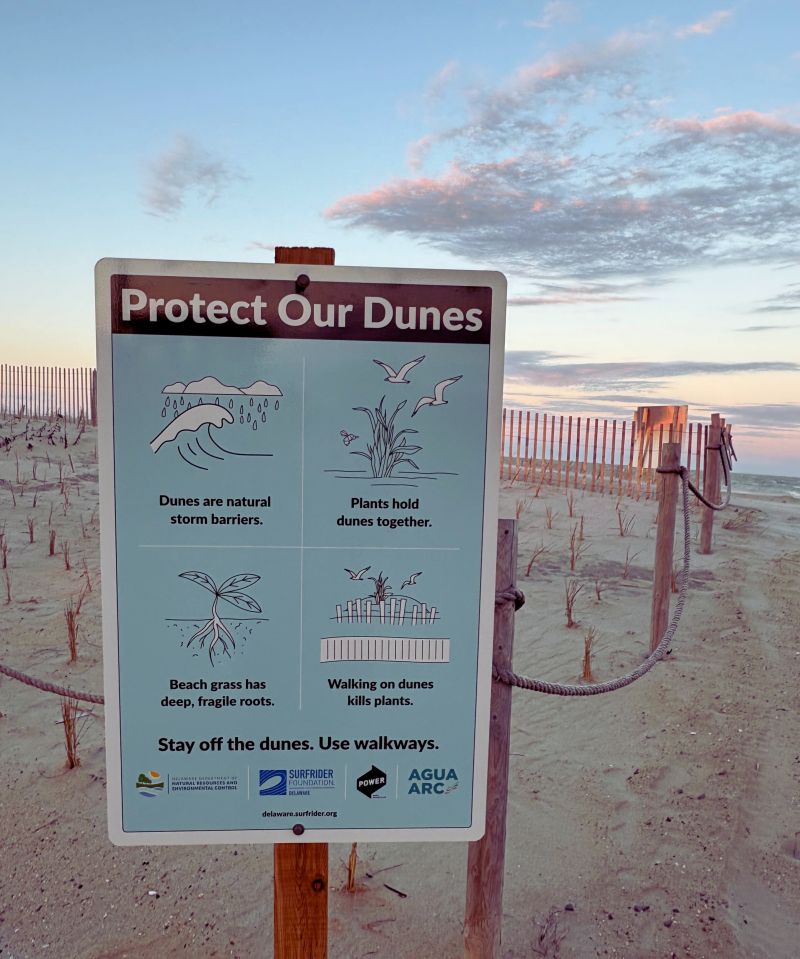
While dunes are a familiar part of the beach landscape, many visitors may not realize just how much they do. Healthy dune systems act as natural barriers against storm surge, flooding, and coastal erosion while providing critical habitat for wildlife and helping protect the communities behind them. Education became a key piece of the solution. A series of informational signs could help bridge that knowledge gap, encouraging visitors to appreciate these fragile ecosystems and understand why protecting them matters.
From there, the project grew into a true community effort. Surfrider Delaware volunteers worked alongside the Delaware Department of Natural Resources and Environmental Control (DNREC), including the Divisions of Watershed Stewardship and Parks and Recreation, Delaware Seashore State Park, and POWER HRG to bring the vision to life.
The process involved researching educational content, identifying strategic locations, aligning messaging with coastal stewardship goals, and developing a plan that would support long-term dune protection efforts. Once funding was secured and the project moved into implementation, it required coordination across multiple partners to finalize content, approvals, fabrication, and installation.
The first two signs were installed in March 2026 at Indian River Inlet Beach, timed just ahead of DNREC’s annual state-led sand dune planting event. Seven additional signs followed at Indian River Inlet and Cape Henlopen State Park, bringing the total to nine. Each sign serves as a small but meaningful reminder to every visitor: these dunes are alive, and they are working hard for us.
If you were at Indian River Inlet this past March, you saw the community in action. Surfers showed up with boards still strapped to their cars. DNREC staff moved through the crowd, training volunteers on how to properly plant dune grass. Kids, seniors, families, and community members all came together with hole-pokers and handfuls of grass, helping strengthen the coastline one plant at a time.
Beyond their beauty, sand dunes are doing serious work. They reduce flooding, absorb storm surge, and act as a buffer between the ocean and the communities behind them. Every storm season, those ridges of sand and grass are quietly protecting roads, homes, infrastructure, and coastal habitats.
And they are fragile. Foot traffic across planted dunes—even well-meaning shortcuts—can set back restoration efforts significantly. That is where education plays an important role. The new signage is a small but powerful tool in a larger effort to encourage simple actions, like staying on designated paths and keeping off planted areas, that help protect these natural systems.
This project is just the beginning. More signs will be installed throughout the Delaware coast in the coming months, and Surfrider Delaware will continue creating opportunities for education, volunteer engagement, and community involvement focused on dune protection and nature-based coastal solutions.
Want to be part of it? Sign up to volunteer at delaware.surfrider.org.
A huge thank-you to everyone who made this possible: to DNREC for their collaboration and stewardship leadership across divisions; to Delaware Seashore State Park for on-the-ground support; to POWER HRG for their generous grant and partnership in bringing the signage project to life; and to the Surfrider Delaware volunteers and community members who continue to show up for the coast.
Together, these efforts are helping protect Delaware’s beaches today while building a stronger, more resilient coastline for generations to come.
See you on the beach!

 As Mid-Atlantic Regional Manager, Kayla supports a vibrant network of volunteer-run chapters along the Atlantic Seaboard. She holds a Bachelor of Science degree in Biology from West Chester University and two years of service in AmeriCorps before her current role.